


October 6, 2026
October 6, 2026
The Prayer journaling podcast ●

Hey, I'm Sara
and I'm here to help you slow down, ask deeper questions and find out what God's really saying to you.
The
Hearing God Starter Kit
See how he's drawing you personally into a deeper relationship with him.


get it now

The Prayer journaling podcast
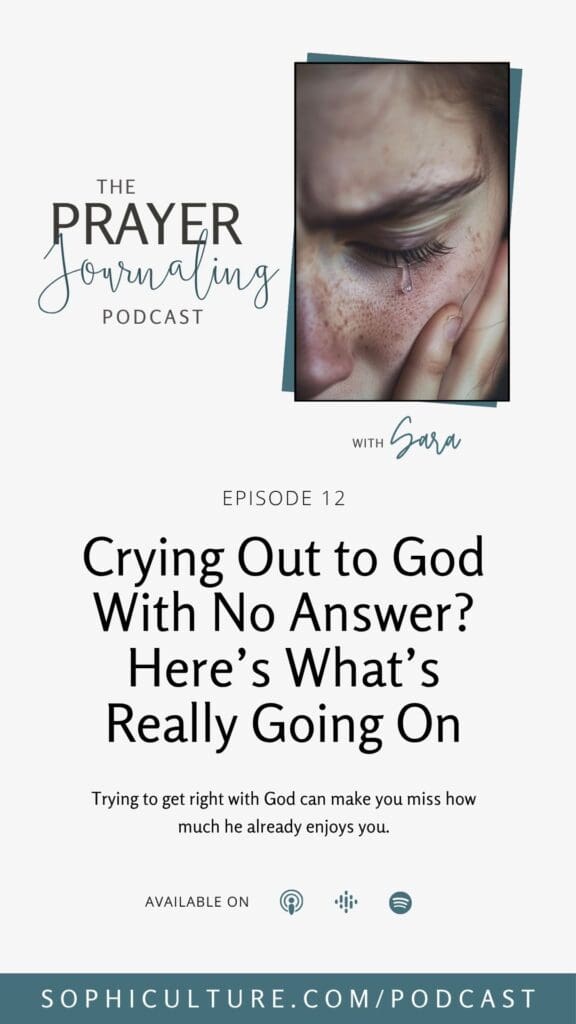
Crying Out to God With No Answer? Here’s What’s Really Going On
Apple Podcasts | Spotify | YouTube
You sit down to pray, but God feels distant. So you start searching yourself. Have I done something wrong? Is there sin I haven’t dealt with? Do I need to get more serious, more disciplined, or more pure before I can feel close to him again?
When prayer feels blocked, it’s easy to start searching yourself for the problem.
In this episode, we’re talking about what happens when that desire to be right with God turns into spiritual self-monitoring, and how to bring the whole struggle directly into conversation with him.
You’ll learn:
- Why feeling distant from God can trigger an exhausting cycle of self-examination
- How trying to make yourself pure enough can actually make the block in your prayer life feel bigger
- What to ask God when you’re afraid he may be disappointed with you
- How the Ask, Write, Test process helps you explore what God may be saying without assuming every thought came from him
- Why God’s enjoyment of you doesn’t begin after you’ve successfully improved yourself
If you’ve been wondering why you can’t feel God’s presence, whether something is wrong with your relationship with God, or how to hear God’s voice when prayer feels stuck, this episode will help you go directly to him with greater confidence.
Links Mentioned
Get our free Hearing God Starter Kit at: Sophiculture.com/guide
Get personal support in your relationship with Jesus in our membership community at: Sophiculture.com/illumination

You sit down to pray because you can’t tell what God’s doing in your life, and before you know it, you’re wondering whether you’ve gotten off track with God. Maybe God felt close before, but lately when you think about him, you feel like there’s some kind of block in your prayer life. You might even think, “I cry out to God, but there’s never an answer.”
What if God doesn’t really want to talk to you? Is there something you can do to get that closeness back again? Maybe you see other people flowing in the Holy Spirit, and you feel bad that sometimes you don’t even feel like praying. But when you sit down to pray, you don’t sense that God’s even interested in what you have to say.
This may cause you to start scrutinizing your life to see if there is any sin going on that might explain the disconnect. You might experience a deep need to become more pure in order to be completely right with God. But then that leads to overanalysis, because we really can’t see ourselves the way God sees us unless he shows us what he’s thinking. And right now, you’re just trying to figure out what you’re doing that’s causing him to pull back from you.
When Staying Right With God Becomes a Burden
I remember early on in my faith journey when I was a kid, I thought I could handle the job of staying spiritually cleaned up and on track. Of course, this caused me to miss out on the pure depth of God’s grace. I had learned how to keep emotional gratification at arms length by satisfying my own desire to stay right with God. And that kept me burdened to always check myself for sin when coming to God.
By the time I was in high school, I felt inadequate and alone when I considered all my desires and ideals. My life had always been about consistent achievement, but I hit the point where all of that became dull and empty. I was so disconnected from what brought me joy that I became clinically depressed.
I just felt stuck in a death trap, and not even my parents could help. I didn’t understand what was causing such a desperate sense of purposelessness. But as I released my entire reputation, bit by bit, and learned to partner with God and others just to be able to function, my self-sufficiency and depression slowly melted away.
When you can’t tell what God’s doing in your life and you don’t sense that he’s interested in what you have to say, it makes sense to check yourself for any sin that might explain the disconnect. You feel a deep need to become more pure so you can be completely right with God again. You want to know what you did wrong and whether it might be causing him to pull back from you.
But there’s a problem with assuming that he’s pulling back from you. Because the enemy causes us to misinterpret God’s motives every chance he gets. You may think that if you can identify your faults and confess them, the purity you will feel afterward will allow you to see yourself as God sees you in your true identity. After all, Jesus said in Matthew 5:8 that the pure in heart will see God. But that’s not the whole story.
When Self-Improvement Stops Working
Before my depression, I assumed God was enjoying the process of helping me improve myself for him. I’d read devotional books and apply lessons from the Bible so I could reassure myself that I was thinking the right way about Christian living. Then I’d journal about anything I was thinking or doing that wasn’t matching those beliefs. This gave me satisfaction that I was maturing and becoming like Christ, even though it was more in my strength than his.
But then I ran into a total block, feeling like I couldn’t do all of this well enough to regain the connection I was desperate for. I hit a dead end. Begging God to fix it brought me nowhere. I had to completely let go of everything I was trying to use to lift that block.
I came to understand that I didn’t have to always be improving myself before God could enjoy being with me. He actually loves his moments just being with me, as I discover the little things he gives me to bring joy in my life.
So if you feel desperate because you can’t tell what God’s doing in your life, it may not be because there’s a problem causing a block between you and God. It may be your own insecurity wondering if he feels disappointed when he thinks about you. Here’s what you can do instead: use the Ask, Write, Test process to find out what he’s really thinking about you right now, so you can work together through any issues you might be facing.
Because here’s the catch: when you can’t tell what God’s doing in your life, it is easy to think the block is on his side of the conversation. Maybe he doesn’t want to talk to you. But before you start trying to figure out what you might have done wrong, first pause and ask, “Lord, I feel insecure, but I want to know what you’re really thinking about me right now. Because the Bible says your thoughts are higher than mine, so the idea that you’re disappointed with me might need to be cast down.”
Making that the first step in your journal gives you something different to begin with. Now you’re not starting with everything you need to fix. You’re finding out whether he’s even worried about all of that right now, in the moment when you first show up to spend time with him. Because the truth is that he might be wanting you to just stop and enjoy his presence, while you’re stuck believing the enemy’s lie that he’s not enjoying yours.
What If There Really Is Sin to Deal With?
Of course, if you have sin going on in your life that you haven’t talked about with him yet, step two of this process would be writing a letter to him about that. Or you could just speak it out. But he doesn’t want us using the sin card to explain why we feel disqualified from his loving attention. That’s why he went to the cross and came out of the tomb.
If you’ve already prayed about your sin and you don’t know his plan for changing the situation, you can ask, “What unmet need is causing me to go to this sin for satisfaction?” Then you can ask, “What’s your original design for meeting that need?” And then if filling that need isn’t his plan at all, you can reason with him how to find satisfaction in a different way.
But let me tell you, trying to fix yourself so you can feel pure enough to see God is the exact trap of self-righteousness that will only make your block feel bigger.
So now let’s move on to step 3: getting his response through the Ask, Write, Test process. Grab your journal or some paper and write, “Lord, what are you actually thinking about me right now?” Then write down the thoughts that come to mind, whether they seem important or not.
Then test what you wrote. Ask, “Does this thought sound like what the God of the Bible would say? Where does the Bible show him thinking this way or not thinking this way?” If you’re not very familiar with the Bible, you could find someone who is and ask them about what you’ve written. But the point here is to rule out anything that’s obviously not what God’s thinking, and keep the rest.
Although we can’t be sure that God is speaking to us, we need to believe that he’s a real person who wants us to know how he feels about us. So we can respond as if he’s speaking, and trust that he will help us improve our listening skills over time.
For more help developing this skill, you can get the full Ask, Write, Test training at sophiculture.com/guide.
When You Feel Like God Won’t Answer You
The next time you feel like God won’t answer you, remember that it’s just a trap. You can get around this by going directly to God in your prayer journal for what you need. Your ongoing sin doesn’t have to feel like a burden that never gets addressed.
You can trust that when you go to God and his Word to meet your emotional needs, he will expose where you need to change and guide you through that, even if it takes a long healing process. And you can ask him for the courage to talk to him about whatever comes up, knowing he is on your side and not against you.
Now, let’s talk about the ditch on the other side of the road. A close, ongoing relationship with God is designed to be the central hub of everything else that goes on in your spiritual life. A mind that’s receiving from various streams of Holy Spirit input is more protected from getting off-track than a mind that thinks alone with the Lord.
If you focus on prayer without nurturing your friendships with other Christians, taking time to study what the Bible teaches, and praise God with worship and thanksgiving, you may not have the input from outside sources that makes your Ask, Write, Test process so rich. So when I say go directly to God, I mean to notice all the different ways he’s giving you insight and then journal those insights directly with him, instead of letting mental blocks convince you to procrastinate your moments of prayer.
And here’s one more tip before we close: when you go to him, treat him as if he’s enjoying you the entire time you’re talking with him, and use whatever kind of prayer brings the deepest satisfaction as you sense what you need from him.
Any time you feel tension, remember: “Go lower and slower” in order to accelerate growth. When we do things at a natural pace, it may be hard to see growth as things change. But that’s how God sets the foundation in place so that later we can look back and see that something real and lasting has been built.
Trusting that God’s On Your Side
Now, let’s recap: it’s normal to be in a season where you can’t tell exactly what God’s doing in your life. Sometimes we hear preaching that encourages us to search our souls for unconfessed sin we may need to bring to God. You might be tempted to try to figure out where you’ve gone wrong if you feel a block when you start to pray.
But trying to monitor your side of the relationship too closely can be a trap, because we need God to show us what actually needs to be dealt with and guide us through it. If you notice yourself wanting to be sure that you’re thinking and living the right way, bring that desire into your conversation with God.
Come to him when you feel insecure, when you don’t sense his presence, and when you can’t tell how he’s leading you. Ask him what he’s really thinking about you. Then write down whatever comes to mind and consider whether he might be showing you something.
Keep bringing him whatever comes up: the things you want to change, the needs you’ve been trying to satisfy in the wrong ways, the disappointment you feel in yourself, and the moments when you don’t know how to pray.
The kind of growth that dissolves self-righteousness may be hard to notice while it is happening. Hearing God clearly takes time, Bible study, worship, friendship with other Christians, and wise input from outside yourself.
But every time you choose to go directly to God with what you’re feeling, you’re building something deeper than a temporary feeling of closeness. You’re trusting that he’s on your side, not against you.
Let’s Pray This
Lord, I don’t always want to stop and think about why I feel the way I do. It’s often easier to just write a prayer than it is to listen for an answer. Remind me when I feel impatient that going lower and slower is worth the extra time and energy.
I love feeling confident that you’re supporting me, instead of insecure about what you feel about me. Train me to value those moments of connection as the one thing that makes my life worth living. Amen.
Next Steps:
Get our free Hearing God Starter Kit at: Sophiculture.com/guide
Get personal support in your relationship with Jesus in our membership community at: Sophiculture.com/illumination

Sara Tucker is a prayer life coach and founder of Sophiculture Ministries. She helps committed Christians cultivate intimacy with God, recognize his involvement in their everyday lives, and develop a personal, interactive relationship with him through scripture and prayer journaling.
Previous Episode
Next Episode
freebie
community
Grab our free "Hearing God Starter Kit," and learn how to develop a 2-way conversation about what matters most
podcast
Get the prayer journaling wisdom and clarity you need to face life from a deep security in the Father's love.
Join "Illumination" and get the teaching and support that you need to build a thriving friendship with Jesus.
more info
Craving a relationship with God?
more info
more info
close


Almost There!
You're all signed up! Keep your eyes on your inbox for your guide. More freebies will arrive later this week!
Done!
