


October 26, 2026
October 26, 2026
The Prayer journaling podcast ●

Hey, I'm Sara
and I'm here to help you slow down, ask deeper questions and find out what God's really saying to you.
The
Hearing God Starter Kit
See how he's drawing you personally into a deeper relationship with him.


get it now

The Prayer journaling podcast
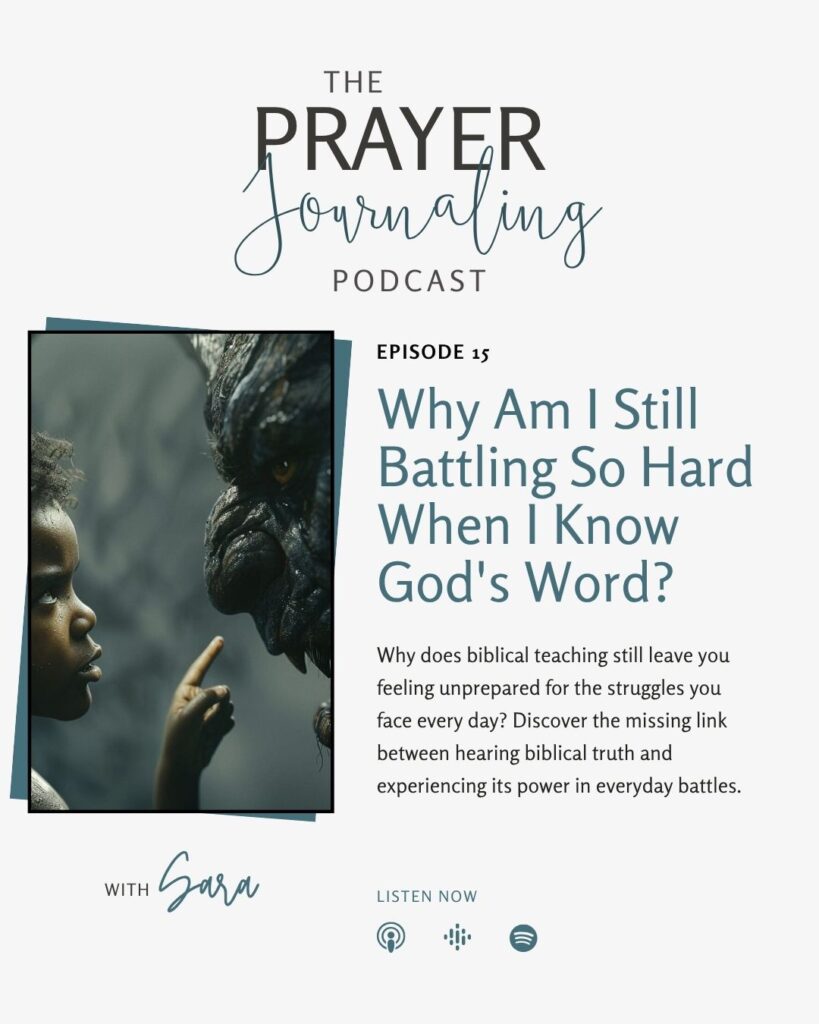
Why Am I Still Battling So Hard When I Know God’s Word?
Apple Podcasts | Spotify | YouTube
You’re following biblical teaching, so why does it still feel like you’re constantly under attack?
You know God’s Word, and you’re applying it to your life. But when the pressure builds in your parenting, finances, or everyday responsibilities, the same frustrations and struggles keep coming back. Sometimes it seems like the more biblical truth you learn, the more intense the battles become.
What does it take for that truth to actually change what’s happening in your life? There’s a reason you can hear excellent preaching and still feel unprepared for the struggles waiting at home. In this episode, we’re exploring how to bring the biblical teaching you already know into your personal conversations with Jesus, so you can begin approaching those battles differently.
You’ll learn:
- Why applying biblical teaching doesn’t always reach the struggles you’re experiencing.
- What recurring frustration can reveal about the battles happening beneath the surface.
- How to recognize the patterns that keep drawing you into the same struggles.
- A practical prayer journaling process for bringing your battles to Jesus.
- How to develop a Scripture-based battle plan for the moments when pressure builds.
If you’re tired of feeling constantly under attack, join me to discover how God’s personal guidance can change the way you experience your everyday battles.
Links Mentioned
Get our free Hearing God Starter Kit and learn the Ask, Write, Test process featured in this episode at: Sophiculture.com/guide
Get support for hearing God about your eating choices at: Sophiculture.com/Wisdom-Fast

You’re following the biblical teaching you hear at church, so why do you still feel like you’re constantly under attack? You know plenty of biblical principles. But sometimes it seems like that just makes you more of a target. If the battle’s not raging in your finances, there’s a struggle going on in your parenting, or health challenges to deal with.
And honestly, sometimes it feels like listening to preaching only scratches the surface of all the guidance we really need from the Lord. What we’re really thirsty for isn’t more instruction, it’s God’s intervention in the everyday struggles.
The Graceful Pace Project
I remember battling frustration when my children were young and we’d be getting ready to go somewhere. I’d be feeling pressured to get everyone out the door on time, and I’d start rushing the kids. When I felt like they just weren’t focusing on getting ready, I’d get angry at them.
Instead of calming down and taking things one step at a time, I’d let my frustration show in the way I spoke to them. As I saw this pattern coming up more and more in my daily life, I began praying about how God was going to help me overcome this battle.
The verse I used for this particular battle plan was Psalm 37:23, “The steps of a good man are ordered by the Lord…” The plan was called The Graceful Pace Project because I was asking God to help me recognize my anger sooner and respond differently when these situations came up.
Now battle planning is one of the tools that I use to help committed Christians as a prayer life coach. Because the truth is that following general Christian teaching isn’t the same thing as turning to Jesus when we’re under attack.
What We Consider Normal Christianity
Even though our Christian friends and family honestly want to live a biblical lifestyle, we don’t always talk about how God is personally leading us.
Each group of Christians has a particular way of living out our faith that’s basically considered normal. We look to our leaders for guidance and biblical information, and try to live by the truth they teach us. But I sometimes wonder if our cultural norms direct us to take responsibility for praying through our battles.
Sure, we pray about them in prayer groups. But a lot of us don’t even realize that applying the Bible when we’re stressed is normal Christianity. Uncovering false beliefs and healing from old coping patterns is what makes the Christian life so fulfilling.
God can use the pressure that builds to expose hidden half-truths undermining our sense of security, identity, and purpose in him. This gets exposed by anxiety and frustration in the areas of our lives where we’re compensating for the needs we’re not bringing to God.
We may tell ourselves we’re too busy, not strong enough, or just distracted. And all of that can keep us from bringing our triggers to Jesus for his healing truth.
But that’s exactly what the Bible shows God’s people doing and failing to do, over and over again.
So I want to talk about how the preaching we hear can be used to support this process, even if the principles themselves have nothing to do with prayer. Because when we have a journaling routine that brings that biblical teaching into what God is already doing in our lives, those principles can shine his light during the moments when we need him most.
Having a Two-Way Conversation With Jesus
If you constantly feel under attack, it may not be because you need more biblical truth. It may be because you’ve never been taught how to have a two-way conversation with Jesus about your struggles.
Here’s what you can do instead: apply the biblical truth you’ve already learned to the specific struggles you’re facing by using a listening process in your prayer journal.
Before we get into the exact instructions for hearing God in a two-way conversation, let’s clarify what we’re doing all of this for.
Expect Personal Transformation
Here’s the first point: Transformation in our lives is one way we enjoy getting to know Jesus through the way he fills our needs and desires.
Seeing our transformations in the pages of Scripture gives us antennae so we notice when other people are also living this way. Once it starts feeling normal to reach for a Bible verse to explain our experience, we’re hearing God naturally.
It’s like we’re living the reality of Colossians 3:16, where it says to let “the word of Christ dwell in you richly in all wisdom.” And Romans 12:2 describes transformation happening through the renewing of our mind so we can know and do what he desires.
We need to expect that we’re not going to reach for what the world normally reaches for to fill our unmet needs. Being free to not conform to this world’s empty solutions gives us space to take ownership of our own spiritual fulfillment.
This is what we call self-awareness, and it goes hand-in-hand with remembering that God is there loving us during our battles.
Recognize the Beliefs and Coping Patterns Behind the Battle
Here’s the second point: self-awareness also leads to recognizing the beliefs and coping patterns behind people’s sinful behaviors.
Once you recognize that there are unhealthy patterns fueling the enemy’s attacks, you can start to identify what needs to change to create a healthy response.
You can notice the feelings, thoughts, and desires that come up inside of you when you’re anxious or frustrated, and then bring those tendencies to him.
Apply Biblical Truth Through Personal Dialogue With Jesus
Here’s the third point: whenever you’re being transformed by Scripture, you’re having a dialogue with Jesus, the Word of God.
The biblical principles you’ve learned from sermons often come to mind when you ask him for the truth about your identity, security, and purpose.
You can use your journal to examine what’s happening and understand how those principles resolve your situation. This gives you something specific to talk about with the Lord when you have free time for more in-depth journaling.
If you’d like some help knowing how to have the kind of conversation with Jesus I’ve been talking about, I’ve put together the Hearing God Starter Kit. You can get it for free at Sophiculture.com/guide.
A Step-by-Step Process for Your Spiritual Battles
I’ll walk you through that now, using the same Ask, Write, Test process we used in previous episodes.
I want you to think of a moment in your daily life that keeps frustrating you or making you anxious. Now we’ll run through what to do next time you’re experiencing this.
Step 1: Recognize the Battle and Pause
Step 1 is to recognize the battle when it’s happening and pause everything.
When you notice that you’re struggling, if possible, find a way to excuse yourself and go someplace alone instead of responding the way you usually would.
Step 2: Write Down Your Feelings, Thoughts, and Desires
Step 2 is to write a short letter to God about your feelings, thoughts, and desires.
Write down what’s happening, how you’re feeling, what you’re thinking, and what you want. This makes it easier to see the half-truths that whisper false beliefs, for example: “I’m not worthy,” or “No one cares about me.”
Step 3: Ask for Specific Healing Truth From Jesus
Step 3 is to ask for specific healing truth from Jesus. This is where we use the Ask, Write, Test process.
Remember that this is a simple way to begin connecting with him, not a shortcut for making big decisions.
First, you can ask him what he wants to show you about what you’ve written in your letter. Write down, “Lord, what do you want me to know about this?”
Then stop and listen to any thoughts you might have. Don’t try to make something special happen, just write down whatever pops into your head.
Then, write down what God might be saying about those thoughts. Imagine God as a loving Father sitting right next to you. Imagine what he might tell you about what you’ve written and write that down too, whether it seems important or not.
You don’t have to know yet whether these words are really coming from God. If your mind goes blank, don’t write anything. Wait until your mind starts moving again and then write down what happens.
Finally, test what you wrote. Does the message on your paper make sense with how the Bible describes God? Where does Scripture show him thinking this way, or show you that this isn’t how he thinks?
If there’s anything you wrote that’s obviously not how God sees things, put a line through it. You can use the rest of it to continue your conversation with him whenever the time is right.
You can trust him to help you sort out which of your thoughts are really from him and which need more testing. And when you’re making important decisions, give yourself time to compare what you’ve written with more Scripture and talk it through with trusted Christian friends.
Step 4: Create a Battle Card
After the Ask, Write, Test process, step 4 is to create a battle card.
Think about a key verse that speaks to you about what you’ve been discussing with Jesus. Write it on a card to use the next time this battle comes up.
If you don’t know which verse to use, get help from a friend or look it up on your phone. Put this card or paper somewhere where you’ll see it next time you need it, so God can replace unhealthy thoughts with his truth.
Using Your Battle Card in Everyday Life
Back when I started The Graceful Pace Project that I told you about, my goal was to keep a loving tone of voice even when my children were disobeying me. When I was tempted to use a frustrated voice, I planned to stop, grab my battle card, and let the Lord speak to me through His words.
I started using these kinds of battle plans even before that moment seven years ago, in 2019. My kids are now 10, 16, and 21 so the frustrations we have aren’t about getting our shoes and jackets on anymore.
But all this time, I’ve kept writing new plans every couple months because it helps me notice my triggers so I don’t get overwhelmed by intense situations.
I’m sharing this with you because I want you to see what it’s like to take charge of your own spiritual life. Not only is this the best way to partner with what God’s already doing, but it’s how we stop dysfunctionally looking to others to fix our problems.
Of course, the way we take charge of our own lives always happens in cooperation with how Holy Spirit is empowering us.
Let the Lord Order Your Steps
If making a battle card feels like leaning unto your own understanding instead of reminding yourself to depend on the Holy Spirit in your struggles, don’t do it.
I’m just trying to validate the part of you that feels like listening to preaching only scratches the surface of what you need from Jesus.
The words of Psalm 37:23 that I used on my card years ago apply to you and me today: “The steps of a good man [or woman] are ordered by the Lord.”
You can try the step-by-step process I laid out in this article and adjust it as you go, as you experience how the Lord is ordering your steps too.
There’s no single right way to turn to Jesus when we’re stressed. Just do what helps you connect with him this week.
Putting Biblical Teaching Into Practice
In the end, the sooner we feel free to become proactive on our side of the relationship with God, the sooner we recognize how he’s meeting us there.
I think that’s really what we’re all looking for more and more, is evidence that he’s paying attention to the little things in our lives and putting them in order.
So when you sense a hunger for more biblical truth, try going directly to Jesus and implementing your favorite sermons and verses in dialogue with him.
This will help us avoid the sense of teaching overload that can come from bingeing on information about Christian living. Use practical tools like this podcast that give you steps to apply the truth you’ve already learned to the specific struggles you’re facing.
Let’s Pray This
Lord, there are so many ways I could develop a healthier, more satisfying lifestyle with you. I want that life ordered with you more than anything the world has to offer. Thank you that you’ve shown me the value of taking it all one step at a time. Give me plenty of time and space this week to just sit and worship you and listen to how you’re leading. Amen.
Next Steps:
Get our free Hearing God Starter Kit at: Sophiculture.com/Guide
Get support for hearing God about your eating choices at: Sophiculture.com/Wisdom-Fast

Sara Tucker is a prayer life coach and founder of Sophiculture Ministries. She helps committed Christians cultivate intimacy with God, recognize his involvement in their everyday lives, and develop a personal, interactive relationship with him through scripture and prayer journaling.
Previous Episode
Next Episode
freebie
community
Grab our free "Hearing God Starter Kit," and learn how to develop a 2-way conversation about what matters most
podcast
Get the prayer journaling wisdom and clarity you need to face life from a deep security in the Father's love.
Join "Illumination" and get the teaching and support that you need to build a thriving friendship with Jesus.
more info
Craving a relationship with God?
more info
more info
close


Almost There!
You're all signed up! Keep your eyes on your inbox for your guide. More freebies will arrive later this week!
Done!
